
Why Keyword Intent Is More Important Than Keyword Volume in SEO (2026)
SEO
3/27/20264 min read
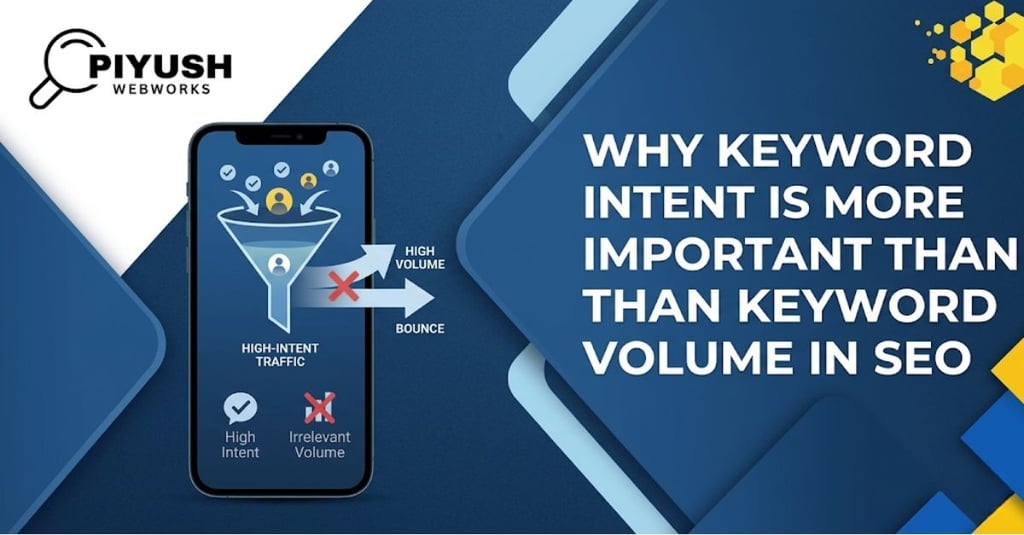
In the present condition of SEO, many marketers are still striving to achieve a high volume of keywords, hoping that it will bring about traffic and success.
The reality is, though, that it is not the traffic that will expand your business, but conversions.
And there is the intent of keywords.
The new era of SEO does not revolve around the number of searchers of a keyword anymore. It is concerning the reason they are seeking. When you get this, you can reach the right audience, not a huge one.
What is Keyword Volume?
Volume of a keyword refers to the average number of searches that a particular keyword gets every month.
For example:
Digital marketing - high volume.
Best SEO company in Faridabad- less volume
The volume of keywords may be attractive, but it is usually broad, non-specific traffic with no conversions.
What is Keyword Intent?
Keywords intent (synonymous with search intent) is what the user actually wants to do or to find in his/her search query.
There are four main types:
Informational - Learning at a minimum, something.
Navigation - finding a specific site.
Business - Alternatives analysis.
Transactional - Ready to do something.
This intent is the key to content performance.
The reason why Keyword Intent is superior to Volume
1. Intent Drives Conversions, not Traffic
High-volume keywords typically attract non-shopping visitors. But intent based key words are accompanied by users who are action-oriented.
For example:
"What is SEO?" - Just learning
Willing to purchase Hire SEO services in Faridabad.
Given that their expectations are aligned with your content, intended users stand a much higher possibility of converting.
This is the reason why conversion based key-word strategies are of interest to other agencies like Piyush Webworks, as opposed to vanity traffic.
2. Greater User Experience = Better Rankings
Google is only set to satisfy the user.
When what you have to say is as it is:
Users stay longer
Bounce rate decreases
Engagement increases
Your page will be rewarded with high positions as it gets what it wants in Google.
Poor suiting on the other end will result in premature withdrawals -harming your SEO work.
3. High Volume does not necessarily equate to high value
The high-volume keywords include some of the following:
Too broad
Highly competitive
Low in conversion
Use a keyword like shoe, anything may be implied, buying, browsing, researching, etc.
The outcome of this misunderstanding is the wastage of time and unproductivity.
Instead, long-tailed explicit intent keywords may be low-volume, yet valuable keywords.
4. Google Preferring Content by Design
The search engines are now much more developed.
Today, Google uses:
AI algorithms
User behavior signals
Context understanding
to discover what the users would actually want.
This means:
In case the content is not purposeful, then it will not rank despite the high content in terms of the number of keywords.
Nowadays, SEO will be applicable and not duplicated in 2026.
5. The Intent helps you to make targeted content
When you consider the purpose of the keywords, then your writing is more purposeful and more effective.
Examples:
Keywords of information - Blog or guide write.
Business keyword - write a comparison.
Transactional keyword - build a service page.
In so doing, you are addressing users across the board of the purchasing process.
Companies like Piyush Webworks utilize the application of such a funnel content strategy to attract and turn the appropriate audience.
How To Learn With Keyword Intention (Examples)
1. Analyze Google SERPs
Enter your keyword and make notes on the kind of content you are going to encounter, i.e., a blog, video, or a service page.
2. Use Intent-Based Modifiers
Look for words like:
"buy", "hire", "best" - High intent
"how", "guide" - Informational
3. Target Long-Tail Keywords
These keywords have:
Lower competition
Clear intent
A greater possibility of being converted.
4. Match Content Format to Intent
Do not redirect blog traffic to the sales page or vice versa- it does not help in gaining interest.
Conclusion
The concept of a keyword volume is a past practice of SEO.
Yes, quantity tells you how many people are seeking, but it will tell you how many people are taking probable action.
In simple words:
Volume will bring people, and intent will bring customers
To realize a growth of any kind, you will need to plan:
Acquiring the behavior of the user.
Coming up with meaningful content.
Attracting the right audience.
And as far as you may decide to have a result-driven approach at SEO, some companies like Piyush Webworks can help in the process of shifting towards dropping traffic-driven SEO to conversion-driven SEO.
Piyush Saini
Founder – Piyush Webworks
Piyush Saini is a website designer and online solutions expert who is enthusiastic about assisting companies in developing a powerful and successful Internet presence. He has collaborated with startups, local companies, and entrepreneurs to design professional websites to facilitate brand awareness, customer contact, and digital expansion. Being the Founder of Piyush Webworks, he is concerned with providing creative and performance-based web solutions that will enable businesses to achieve credibility in the competitive digital market.
In Piyush Webworks, he heads projects that are associated with Website Designing and development, SEO optimization, business website design, and Digital marketing support. His output revolves around creating responsive websites with user-friendly features and optimized for search engines to enhance user experience and assist a business in drawing more potential customers to its online platform.

Let’s Discuss Your Project
Our Services


+91 8595685128
Copyright ©2026 All Rights Reserved
Designed By PIYUSH WEBWORKS
Quick Links
Copyright ©2026 All Rights Reserved